A colleague swears by MagicSchool. Your own AI habit is ChatGPT, open in a tab since last September, already trained on how you like things phrased. Now you’re wondering if you’re missing out on something built specifically for teachers — or if that’s just a fancier wrapper around the exact same technology you’re already using for free. The ChatGPT vs MagicSchool question comes up in every teacher AI group eventually, usually right after someone posts a screenshot of a lesson plan they generated in thirty seconds.
It’s a fair question, and it doesn’t have a one-line answer, because ChatGPT and MagicSchool aren’t really competing for the same job. One is a general-purpose AI assistant that happens to be great at teaching tasks if you know how to prompt it. The other is a tool built from the ground up around the specific, repetitive things teachers do every week. Knowing which is which changes which one you should reach for — and for a lot of teachers, the honest answer ends up being both, for different parts of the job.
The Quick Answer
If you want one purpose-built platform with templates for lesson plans, rubrics, IEP drafts, and parent emails — plus a guardrailed chatbot you can actually let students near — MagicSchool is the safer, faster pick, and its free tier is generous enough to try without a real commitment. If you already know how to write a good prompt and want more flexibility for one-off tasks, general writing, or anything outside the standard teaching-task list, ChatGPT (or its Plus tier) is the more capable, more general tool. Most teachers who’ve tried both end up keeping ChatGPT for open-ended thinking and MagicSchool for the recurring, structured stuff — which is exactly what the rest of this comparison will show you why.
What Each Tool Actually Is
ChatGPT is a general-purpose AI chatbot. It can help you plan a unit, but it can just as easily help you write a wedding toast, debug a spreadsheet formula, or plan a road trip. Nothing about it is teaching-specific out of the box — every bit of classroom usefulness comes from how well you prompt it. That’s a strength if you’re comfortable directing it, and a weakness if you’re not.
MagicSchool is built specifically for K-12 educators, with 80-plus purpose-built tools covering lesson planning, rubric generation, IEP writing, assessment creation, report card comments, and parent communication. Instead of writing a prompt from scratch, you pick a tool, fill in a short form (grade level, subject, topic, tone), and get a structured, standards-aligned output. It also includes MagicStudent, a guardrailed chatbot designed for students to use directly, with safety features general AI tools don’t have out of the box.
Head-to-Head: Where Each Tool Actually Wins
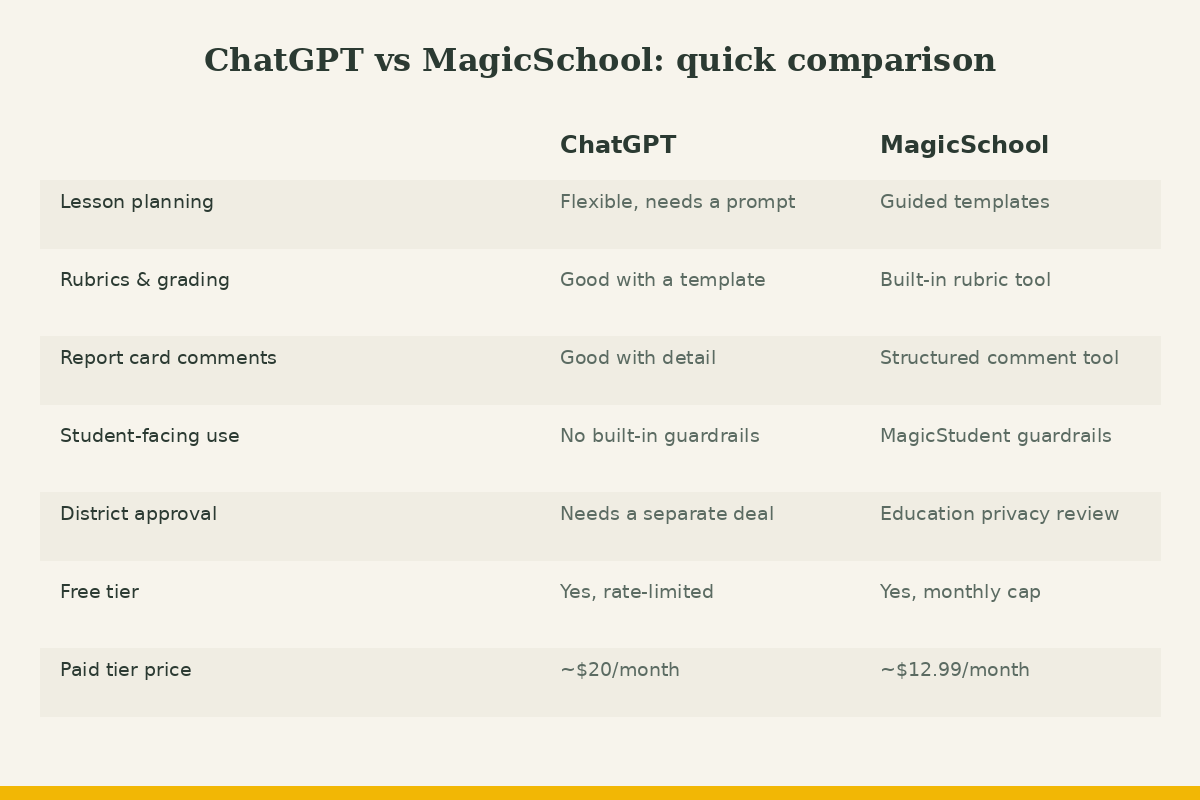
Breaking the ChatGPT vs MagicSchool comparison down task by task shows a clearer pattern than any single overall score could.
Lesson Planning
ChatGPT can absolutely write you a lesson plan — but you’re the one supplying the structure: the standard you’re targeting, the format your school expects, the pacing. Skip any of that and you get a generic plan that needs heavy editing. MagicSchool’s lesson planning tools ask for those specifics upfront through guided fields, which means less prompt-crafting and a first draft that’s closer to usable without you having to remember every input yourself.
Grading, Rubrics, and Feedback
This is where purpose-built tools show their value most clearly. MagicSchool’s rubric generator and feedback tools are built around actual grading workflows — you’re not describing what a rubric should look like, you’re selecting the assignment type and getting one shaped like an assessment tool, not a wall of text. ChatGPT can do this too, and often does it well, but you’re carrying more of the structural work yourself. If you already have a solid rubric prompt template, the gap narrows considerably — see our AI rubric generator guide for exactly that.
Report Card Comments and Parent Communication
Both handle this well, and both have the same core risk: vague input produces generic, corporate-sounding comments regardless of which tool writes it. MagicSchool’s comment tools are structured around the same principle we cover in our AI report card comments guide — specific details in, specific comment out — with the form fields nudging you toward giving that detail. ChatGPT gets you there too, provided you remember to prompt it that way yourself.
Student-Facing Use
This is the category with the clearest winner. MagicStudent was purpose-built with guardrails for direct student use, and MagicSchool has made deliberate safety choices here — including retiring a named chatbot persona specifically to reduce the risk of students forming an attachment to it. General ChatGPT was not built with K-12 student safety as the design brief, and putting it directly in front of students without careful setup is a meaningfully different risk profile. If any part of your workflow puts an AI chatbot directly in front of a student, that difference alone may decide this comparison for you.
Privacy and District Approval
MagicSchool is built around education-specific privacy commitments and has undergone third-party privacy review specifically for K-12 use, which is part of why so many districts have added it to their approved-tool lists at scale. A personal ChatGPT account almost never carries that same district-level agreement — using it with real student data puts the entire burden of anonymizing that data on you, not the platform. We cover exactly how to do that safely in our student data privacy checklist, and it’s worth reading regardless of which tool you land on.
Price
Price is often the first thing teachers ask about when comparing ChatGPT vs MagicSchool, so here’s the breakdown side by side.
| Plan | ChatGPT | MagicSchool |
|---|---|---|
| Free tier | Yes — capable, rate-limited at busy times | Yes — full tool catalog, monthly generation limits |
| Individual paid tier | ChatGPT Plus, roughly $20/month | MagicSchool Plus, roughly $12.99/month (about $8.33/month billed yearly) |
| School/district tier | Enterprise agreements, custom pricing | Enterprise, custom pricing with admin dashboards and district-level agreements |
On price alone, MagicSchool’s individual paid tier is the cheaper of the two — but that’s not really the right way to compare them, since you’re paying for different things: broader general capability on one side, deeper teaching-specific structure on the other. Worth noting too: MagicSchool’s free tier caps monthly generations, which can pinch during report-card week or the start of a new unit when you’re using it heavily in a short window. ChatGPT’s free tier has its own limits during high-traffic periods rather than a hard monthly cap, which changes when each tool’s free ceiling actually shows up in your workflow.
Where ChatGPT Wins
- Anything outside the standard teaching-task list — a tricky email to a colleague, brainstorming a fundraiser idea, explaining a concept a different way for yourself before you teach it.
- Flexibility. If MagicSchool doesn’t have a tool for exactly what you need, ChatGPT will still attempt it — you just have to describe it yourself.
- One tool for your whole life, not just your teaching life, if you’re already using it for personal tasks too.
Where MagicSchool Wins
- Speed on recurring tasks. Guided fields beat writing a fresh prompt every single time you need a rubric or a lesson plan.
- Consistency across a department or school, since everyone’s pulling from the same structured tools instead of everyone’s individually-crafted prompts.
- Safer student-facing use, through MagicStudent’s guardrails.
- Easier district approval, thanks to education-specific privacy commitments many schools have already vetted.
Can You Use Both?
Plenty of teachers do, and it’s a reasonable way to land on this. A common split: MagicSchool for the recurring, structured work — lesson plans, rubrics, report card comments, anything a student might directly touch — and ChatGPT for the one-off, open-ended thinking that doesn’t fit a template. Neither tool loses much by being paired with the other, and the free tiers on both make testing this split cost nothing but a little time.
Who Should Pick Which
The ChatGPT vs MagicSchool decision looks different depending on where you’re starting from. If you’re new to using AI in the classroom and want less to figure out, start with MagicSchool’s free tier — the guided structure does a lot of the thinking for you, and the guardrails matter if students will ever see the output directly. If you’re already comfortable prompting AI tools and want maximum flexibility for a wide range of tasks — including plenty that have nothing to do with teaching — ChatGPT (free or Plus) is the more capable general tool. If your school is choosing a platform for everyone, MagicSchool’s district-level privacy agreements and admin dashboards make it the easier institutional sell.
Elementary teachers juggling many subjects in one day tend to lean toward MagicSchool simply because switching between its tools is faster than re-explaining context to ChatGPT every time the subject changes. Secondary subject specialists — especially in niche electives MagicSchool’s templates don’t cover as deeply — often find ChatGPT’s flexibility does more heavy lifting once you’re past the basics. Special education teachers drafting IEP language benefit from MagicSchool’s education-specific templates, though the actual goals and accommodations still need to come from your own knowledge of the student, not either tool.
It’s also worth knowing the scale MagicSchool operates at, since it affects how quickly rough edges get fixed: the platform has grown to several million registered educators and thousands of partner school districts since launching in 2023, backed by real venture funding specifically aimed at education AI. That kind of scale doesn’t guarantee quality, but it does mean bugs get reported and patched faster than a smaller, newer tool, and it’s part of why so many districts already have it vetted.
A Week Compared: Same Tasks, Both Tools
Numbers and feature lists only tell you so much. Here’s what a fairly normal teaching week looks like run through each tool, side by side.
Monday — planning next week’s unit. In ChatGPT, you’d write a prompt describing the standard, grade level, and format you want, then iterate a couple of times to get the structure right. In MagicSchool, you’d open the lesson plan tool, fill in the same information across guided fields, and get a first draft in roughly the same time — with less chance of forgetting to mention something, since the form asks for it.
Wednesday — building a rubric for Friday’s project. Both tools can do this well. MagicSchool’s rubric tool is shaped like an actual rubric from the first output; ChatGPT will get there too, but you’re more likely to need a follow-up message asking it to reformat into rows and columns rather than a paragraph description.
Thursday night — report card comments. This is the task most likely to expose a real difference. If you’ve got 28 comments to write and you’re tired, MagicSchool’s structured comment tool nudges you toward the specific details that make a comment sound human — the same principle from our report card comments guide. With ChatGPT, that nudge has to come from your own prompt discipline, which gets harder around comment number 20.
Friday — a genuinely odd request. A parent emailed something unusually specific, or you need help thinking through a seating chart problem that doesn’t fit any template. This is where ChatGPT pulls ahead — it’ll engage with almost anything you throw at it, while MagicSchool’s strength (structure) becomes a mild limitation once you’re outside its built tool list.
Across a full week, neither tool “wins” outright. The pattern that emerges is the one worth remembering: structured, repeated tasks favor MagicSchool; unusual, one-off tasks favor ChatGPT.
Common Concerns, Answered Honestly
“Will using either tool make me sound like a robot?” Only if you let it guess. Both tools produce generic output when you give them generic input, and both produce something that sounds like you when you feed them specific, slightly messy real details. This isn’t a tool problem, whichever side of the ChatGPT vs MagicSchool split you land on — it’s a habit, and it’s the same habit either way.
“Is one of these going to replace lesson planning as a skill?” No, and treating either tool that way is where AI use in a classroom tends to go wrong. Both are drafting assistants. The judgment about what a specific group of students needs next still has to come from you — no tool comparison changes that part.
“What if my district hasn’t approved either one yet?” Ask before you adopt either at scale with real student data. MagicSchool’s education-specific privacy agreements make that conversation easier in most districts, but “easier” isn’t “automatic” — check your own school’s approved-tool list first either way.
Frequently Asked Questions
ChatGPT vs MagicSchool: which one should a new teacher start with?
A new teacher figuring out the ChatGPT vs MagicSchool question for the first time is usually better off starting with MagicSchool’s free tier — the guided structure means less trial and error while you’re already learning everything else about the job. ChatGPT is worth adding once you’re comfortable prompting and want more flexibility for tasks outside the standard list.
Is MagicSchool better than ChatGPT for teachers?
“Better” depends on the task. For structured, recurring teaching work — lesson plans, rubrics, report card comments — MagicSchool’s purpose-built tools usually get you to a usable draft faster. For open-ended tasks or anything outside the standard teaching-task list, ChatGPT’s general capability wins. Many teachers use both for different parts of the job.
Is MagicSchool free for teachers?
Yes — MagicSchool offers a free tier for individual educators with access to its full tool catalog, though with monthly generation limits. A paid Plus tier removes those limits for teachers who use it heavily.
Is it safe to let students use ChatGPT directly?
General ChatGPT wasn’t built with K-12 student safety as its core design brief, so putting it directly in front of students without careful setup and school policy review carries more risk than a tool like MagicStudent, which was purpose-built with student guardrails from the start.
Do school districts approve MagicSchool more easily than ChatGPT?
Often, yes. MagicSchool has invested specifically in education-focused privacy review and district-level agreements, which is part of why it appears on so many approved-tool lists already. A personal ChatGPT account typically doesn’t carry that same district-level agreement unless your school has separately signed an enterprise agreement with OpenAI.
Can MagicSchool and ChatGPT be used together?
Yes, and many teachers already do this without thinking of it as a formal strategy — MagicSchool for the recurring, structured tasks like lesson plans and rubrics, ChatGPT for one-off questions and anything outside MagicSchool’s tool list. Both have free tiers, so testing the split costs nothing but a little time.
The Bottom Line
Neither tool is objectively “the winner” here — they’re solving slightly different problems. The ChatGPT vs MagicSchool decision really comes down to what you do most: recurring, structured teaching tasks point to MagicSchool; open-ended, varied work points to ChatGPT. And if you can’t decide, the free tiers on both mean you don’t actually have to — you can try the split for a few weeks and let your own workflow tell you which one earns the other’s spot.
For more on choosing the right AI tool for your specific classroom needs, our complete guide to AI tools for teachers covers the wider field beyond just these two.