GPA Calculator: Calculate Your Grade Point Average Easily and Accurately
Choosing the right academic path, tracking your performance, and maintaining a good academic record all depend on understanding your grades. A GPA Calculator makes this process simple by helping students quickly calculate their Grade Point Average without doing complicated manual calculations.
Whether you are a high school student, college student, university student, or someone applying for scholarships, knowing your GPA can help you understand your academic progress and make better decisions for your future. With an accurate GPA Calculator online, you can calculate your semester GPA, cumulative GPA, and overall academic standing within seconds.
Many students struggle with GPA calculations because different institutions use different grading systems, credit hours, and GPA scales. A reliable GPA calculator removes this confusion by automatically applying the correct formula and providing an accurate result.
What Is a GPA Calculator?
A GPA Calculator is an online tool designed to calculate a student’s Grade Point Average based on their grades and credit hours. GPA represents the average academic performance of a student and is commonly used by schools, colleges, and universities worldwide.
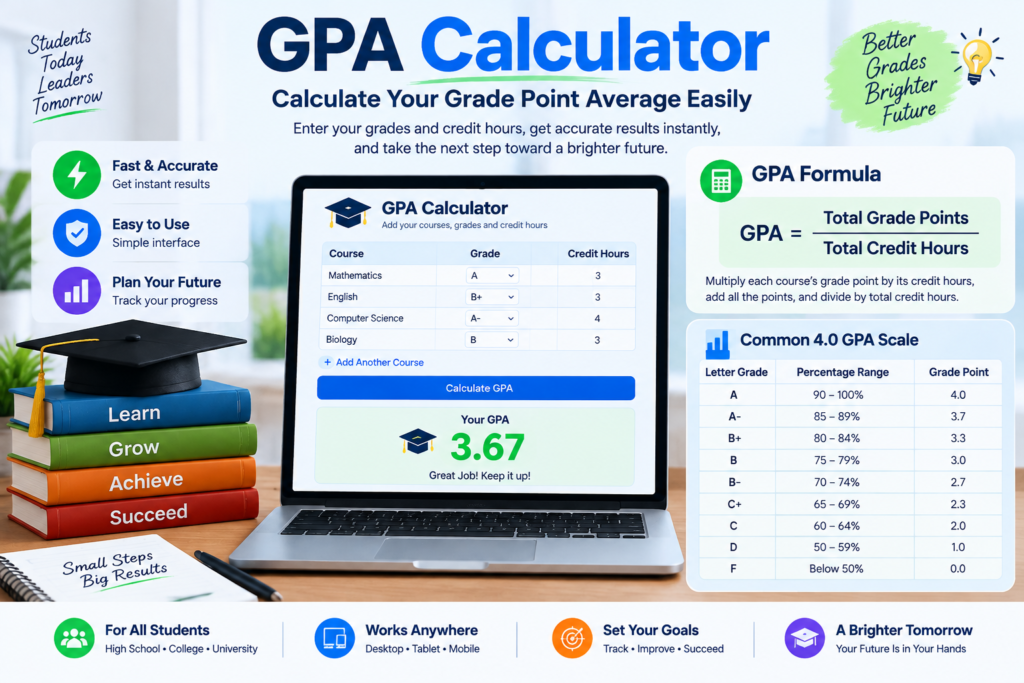
Instead of manually calculating every course grade, students can enter their subjects, grades, and credit hours into the calculator. The tool then calculates the final GPA instantly using the standard GPA calculation formula.
For example, if you have five courses with different grades and credit values, calculating the GPA manually requires multiple steps. A GPA calculator handles these calculations automatically, reducing mistakes and saving valuable time.
Why Is a GPA Calculator Important for Students?
GPA grading systems may vary between institutions. You can check official academic grading guidelines from your university or educational organization for accurate information.
Academic performance plays an important role in admission opportunities, scholarships, internships, and career growth. A GPA calculator helps students stay aware of their current academic position and plan improvements when needed.
Here are some major benefits of using a GPA calculator:
- Quick and accurate calculations: Get your GPA result within seconds without manual mathematics.
- Error-free results: Avoid common calculation mistakes related to credit hours and grade points.
- Academic planning: Understand what grades you need in future semesters to achieve your target GPA.
- Scholarship preparation: Track whether your GPA meets scholarship requirements.
- Career planning: Many employers and graduate programs consider GPA during evaluation.
How Does a GPA Calculator Work?
If you want to calculate your overall academic performance, you can use our CGPA Calculator to find your cumulative grade point average.
A GPA calculator works by converting your course grades into grade points and calculating the average based on your credit hours. The calculation is based on a simple mathematical formula.
The basic GPA formula is:
GPA = Total Grade Points ÷ Total Credit Hours
Each course contributes grade points depending on the grade received and the number of credit hours assigned to that course.
Understanding Grade Points and Credit Hours
To understand GPA calculation properly, it is important to know two basic concepts: grade points and credit hours.
Grade Points
Grade points are numerical values assigned to letter grades. Most universities use a 4.0 GPA scale where each grade has a specific point value.
| Letter Grade | Grade Point |
|---|---|
| A | 4.0 |
| A- | 3.7 |
| B+ | 3.3 |
| B | 3.0 |
| B- | 2.7 |
| C+ | 2.3 |
| C | 2.0 |
| D | 1.0 |
| F | 0.0 |
Credit Hours
Credit hours represent the academic value or workload of a course. A course with more credit hours has a greater impact on your GPA compared to a course with fewer credit hours.
For example, receiving an A grade in a 4-credit course improves your GPA more than receiving an A grade in a 1-credit course because the higher-credit course contributes more total grade points.
How to Calculate GPA Manually?
Although a GPA calculator makes the process easier, understanding manual calculation helps students know how their academic score is created.
Follow these simple steps:
- Convert each grade into grade points.
Example: A = 4.0, B = 3.0, C = 2.0 - Multiply grade points by credit hours.
This gives you the total grade points for each course. - Add all grade points together.
- Add all credit hours together.
- Divide total grade points by total credit hours.
GPA Calculation Example
Let’s understand GPA calculation with a simple example.
| Course | Grade | Grade Point | Credit Hours | Total Points |
|---|---|---|---|---|
| Mathematics | A | 4.0 | 3 | 12 |
| English | B+ | 3.3 | 3 | 9.9 |
| Computer Science | A- | 3.7 | 4 | 14.8 |
Total Grade Points: 36.7
Total Credit Hours: 10
GPA = 36.7 ÷ 10 = 3.67
Therefore, the student’s GPA is 3.67.
Semester GPA vs Cumulative GPA
Students often confuse semester GPA and cumulative GPA. Both are related but represent different measurements of academic performance.
Semester GPA
Semester GPA represents your performance during a single academic semester. It only includes courses completed during that specific term.
Cumulative GPA
Cumulative GPA represents your overall academic performance throughout your entire academic program. It combines all completed semesters.
For example, if your first semester GPA is 3.5 and second semester GPA is 3.8, your cumulative GPA will be calculated by combining all courses and credit hours from both semesters.
How to Use an Online GPA Calculator?
Using a GPA calculator online is very simple. Most calculators require only a few details:
- Select your GPA scale (4.0, 5.0, or custom scale).
- Enter your course names.
- Select your grades.
- Add credit hours for each course.
- Click calculate to get your GPA result.
A good GPA calculator should support multiple grading systems and provide accurate results without requiring complicated steps.
Understanding the 4.0 GPA Scale
The 4.0 GPA scale is the most commonly used grading system in many schools, colleges, and universities. In this system, the highest possible GPA is 4.0, which usually represents excellent academic performance.
Different institutions may use slightly different grade conversion methods, but the 4.0 scale provides a standard way to compare student performance.
| Grade | Percentage Range | GPA Value | Performance Level |
|---|---|---|---|
| A | 90-100% | 4.0 | Excellent |
| A- | 85-89% | 3.7 | Very Good |
| B+ | 80-84% | 3.3 | Good |
| B | 75-79% | 3.0 | Above Average |
| C | 70-74% | 2.0 | Average |
| D | 60-69% | 1.0 | Pass |
| F | Below 60% | 0.0 | Fail |
GPA vs CGPA: What Is the Difference?
Many students search for GPA and CGPA calculators because they are unsure about the difference between these two terms. Although both measure academic performance, they represent different periods of study.
What Is GPA?
GPA (Grade Point Average) measures your academic performance during a specific period, usually one semester or academic term.
For example, if you complete five courses in your spring semester, the GPA calculator will calculate your performance only for those courses.
What Is CGPA?
CGPA (Cumulative Grade Point Average) represents your overall academic performance throughout your complete degree or program.
It combines all semester GPAs and provides a complete picture of your academic achievement.
| Feature | GPA | CGPA |
|---|---|---|
| Meaning | Grade Point Average | Cumulative Grade Point Average |
| Coverage | Single semester | Entire academic program |
| Calculation | Current courses only | All completed courses |
| Used For | Semester performance tracking | Graduation and overall evaluation |
How to Convert GPA Into Percentage?
Students often need GPA to percentage conversion when applying for jobs, universities, or international programs. However, the conversion method depends on the institution’s grading policy.
A commonly used formula is:
Percentage = GPA ÷ Maximum GPA × 100
For example:
If your GPA is 3.5 on a 4.0 scale:
3.5 ÷ 4.0 × 100 = 87.5%
Your estimated percentage would be approximately 87.5%.
Keep in mind that some universities use their own conversion tables, so always check official guidelines before submitting applications.
How to Improve Your GPA?
Improving GPA requires consistent effort, smart study techniques, and proper academic planning. A GPA calculator helps you identify your current position, but improving your score depends on your daily habits.
Here are practical strategies students can follow:
1. Understand Your Current GPA
Before creating an improvement plan, calculate your current GPA accurately. Knowing your weak areas helps you focus on courses that have the biggest impact on your overall score.
2. Prioritize High-Credit Courses
Courses with higher credit hours have a greater impact on your GPA. Improving grades in these subjects can significantly increase your overall average.
3. Create a Realistic Study Schedule
Consistency is more effective than last-minute preparation. Divide your study time according to course difficulty and upcoming deadlines.
4. Ask Teachers for Feedback
Teachers can identify mistakes that students often overlook. Regular feedback helps you improve assignments, exams, and understanding of difficult topics.
5. Practice Before Exams
Reviewing previous exams, solving practice questions, and testing yourself regularly can improve exam performance.
6. Avoid Missing Assignments
Assignments, quizzes, and projects often contribute to your final grade. Missing small tasks can negatively affect your GPA.
Common Mistakes Students Make While Calculating GPA
Although GPA calculation looks simple, students often make mistakes that lead to incorrect results.
- Ignoring credit hours: Calculating only grades without considering course credits gives an incorrect GPA.
- Using the wrong GPA scale: Some institutions use 4.0, 5.0, or custom grading systems.
- Confusing GPA with percentage: GPA and percentage are different grading measurements.
- Forgetting repeated courses: Universities may have special rules for repeated subjects.
- Manual calculation errors: Small mathematical mistakes can change the final result.
Who Can Use a GPA Calculator?
A GPA calculator is useful for almost every student who wants to track academic progress.
- High school students
- College students
- University students
- Graduate students
- Scholarship applicants
- Students applying abroad
- Academic advisors
Why Use a GPA Calculator Online Instead of Manual Calculation?
Manual GPA calculation requires time and attention to detail. A single mistake in adding credit hours or grade points can produce an incorrect result.
An online GPA calculator provides several advantages:
- Instant results
- Higher accuracy
- No mathematical calculations required
- Easy semester tracking
- Works anytime on mobile and desktop devices
Frequently Asked Questions About GPA Calculator
What is a GPA calculator?
A GPA calculator is an online tool that calculates your Grade Point Average by using your grades and credit hours.
How do I calculate my GPA?
You can calculate GPA by multiplying each course grade point by its credit hours, adding all results, and dividing by total credit hours.
Is a 3.5 GPA good?
Yes, a 3.5 GPA is generally considered a strong academic performance and may qualify students for many scholarships and graduate programs.
What is a perfect GPA?
On a standard 4.0 GPA scale, a perfect GPA is 4.0.
Can GPA calculators work for different universities?
Yes, many advanced GPA calculators support different grading scales, but students should verify their institution’s official grading system.