Student Participation Tracker: Improve Classroom Engagement and Student Success
Keeping students engaged during lessons is one of the biggest challenges teachers face today. In every classroom, some students actively participate, ask questions, and share ideas, while others may remain quiet even when they understand the topic.
A Student Participation Tracker helps teachers understand how students engage with classroom activities, discussions, teamwork, and learning experiences. Instead of relying only on memory or assumptions, teachers can use structured tracking methods to create a clearer picture of student involvement.
Student participation is not only about counting how many times a student answers a question. True engagement includes discussions, group activities, presentations, collaboration, asking questions, and contributing ideas.
With modern classroom technology, teachers can organize participation data more effectively and create learning environments where every student has an opportunity to be heard.
What Is a Student Participation Tracker?
A Student Participation Tracker is a tool or system that helps teachers record, monitor, and analyze student involvement in classroom activities.
It allows educators to track different types of participation, such as:
- Answering questions
- Joining classroom discussions
- Completing group activities
- Sharing ideas
- Participating in projects
- Collaborating with classmates
- Taking leadership roles
Unlike traditional grading methods that focus mainly on final results, participation tracking helps teachers understand the learning process behind those results.
For example, a student who rarely speaks in class may still show strong engagement through written activities, teamwork, and thoughtful contributions. A good tracking system helps teachers notice these different forms of participation.
Why Teachers Need a Student Participation Tracker
Teachers manage many responsibilities every day. They prepare lessons, check assignments, answer questions, support students, and maintain classroom organization.
Because of these responsibilities, remembering every student’s participation over weeks or months can become difficult.
A Student Participation Tracker provides a simple way to organize this information and make better teaching decisions.
1. Understand Student Engagement Better
One of the biggest benefits of participation tracking is gaining a clearer understanding of student engagement.
Teachers can identify:
- Students who participate frequently
- Students who need more encouragement
- Students who contribute in different ways
- Classroom activities that create more engagement
This information helps teachers adjust their teaching strategies according to student needs.
2. Encourage Quiet Students to Participate
Every classroom has students who are less likely to raise their hands or speak in front of others.
A Student Participation Tracker helps teachers notice these patterns and create opportunities for quieter students to become more involved.
For example, a teacher may use small group discussions, written responses, or partner activities to help students gradually build confidence.
3. Create Fair Participation Opportunities
Without tracking, teachers may unintentionally call on the same students repeatedly because they are more visible during lessons.
A participation tracker helps create a more balanced classroom where different students receive opportunities to contribute.
Fair participation does not mean forcing every student to participate in exactly the same way. It means recognizing different types of engagement and providing suitable opportunities.
Student Participation Tracker vs Traditional Classroom Observation
Many teachers already observe student behavior naturally. However, relying only on memory can become challenging, especially with large classes.
| Traditional Observation | Student Participation Tracker |
|---|---|
| Based mainly on teacher memory | Uses organized participation records |
| Difficult with large classrooms | Makes tracking easier |
| May miss small contributions | Records different participation types |
| Takes more mental effort | Simplifies classroom management |
| Hard to compare progress over time | Helps identify participation trends |
How Does a Student Participation Tracker Work?
A Student Participation Tracker can be simple or advanced depending on the needs of the teacher.
Most systems follow a basic process:
Step 1: Define Participation Goals
Before tracking participation, teachers should decide what they want to measure.
Examples include:
- Class discussions
- Question responses
- Teamwork
- Creative contributions
- Project involvement
Clear goals make tracking more useful and meaningful.
Step 2: Record Student Activities
Teachers can record participation during or after classroom activities.
Records may include:
- Student name
- Activity type
- Date
- Participation notes
- Teacher feedback
Step 3: Review Participation Patterns
Over time, participation records help teachers identify patterns.
A teacher may discover that:
- A student participates more in group activities
- A student needs confidence-building support
- A specific teaching method improves engagement
Key Features of an Effective Student Participation Tracker
A useful participation tracking system should be simple, flexible, and focused on helping teachers.
Easy Student Management
Teachers should be able to add students, update information, and organize classes without unnecessary complexity.
Multiple Participation Categories
Participation is not limited to answering questions. A good tracker should support different classroom activities.
Progress History
Tracking participation over time helps teachers understand improvement and changing student needs.
Simple Notes and Feedback
Teacher observations provide valuable context that numbers alone cannot show.
Classroom-Friendly Design
Teachers need tools that work quickly during busy lessons without creating extra workload.
Benefits of Using a Student Participation Tracker
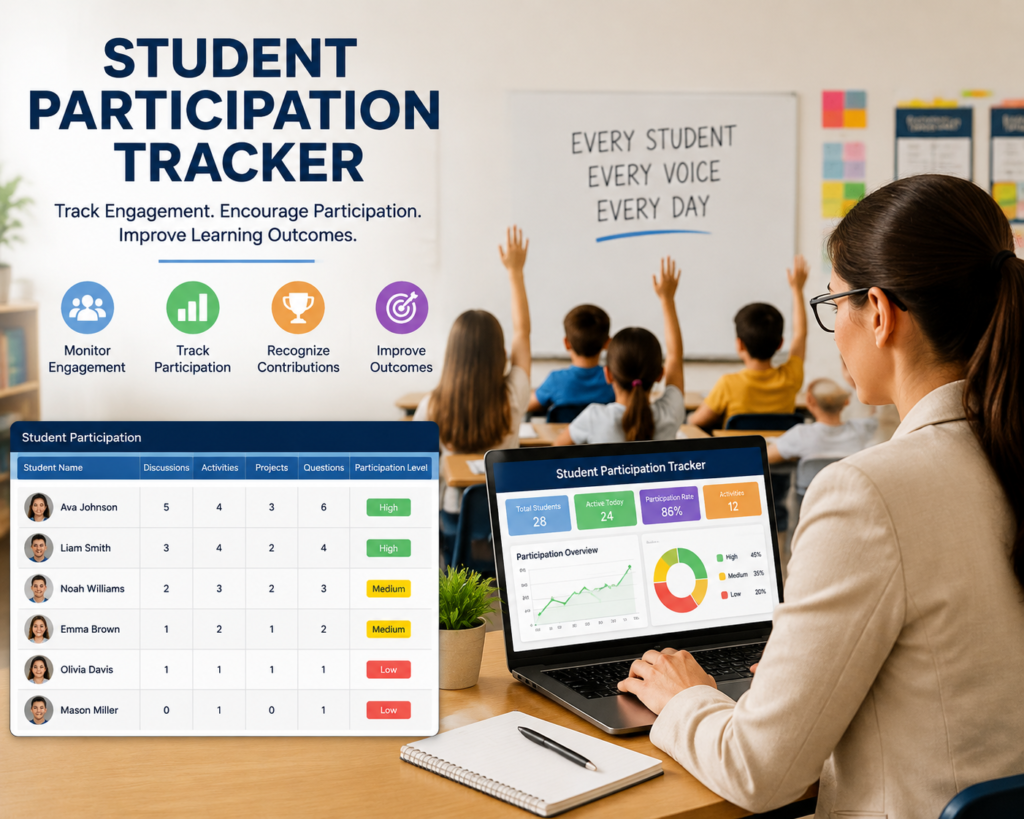
A Student Participation Tracker is more than a record-keeping tool. When used correctly, it helps teachers create more engaging classrooms and make better decisions about student learning.
1. Improves Classroom Engagement
Student engagement is one of the strongest indicators of effective learning. When students actively participate, they usually understand concepts better and develop stronger communication skills.
A Student Participation Tracker helps teachers identify which activities encourage students to participate more actively.
For example, a teacher may notice that students participate more during:
- Group discussions
- Interactive activities
- Hands-on projects
- Problem-solving tasks
- Classroom debates
This information allows teachers to design lessons that encourage more meaningful participation.
Teachers can also explore research and teaching strategies from trusted education resources such as Edutopia to improve student engagement and classroom learning.
2. Helps Teachers Provide Better Support
Every student learns differently. Some students participate by speaking, while others show engagement through writing, teamwork, or creative activities.
A participation tracker helps teachers understand individual learning patterns and provide better support.
For example:
- A quiet student may need confidence-building activities
- An active student may need leadership opportunities
- A struggling student may need additional guidance
3. Supports Personalized Learning
Modern education focuses more on personalized learning. Teachers need information about student progress to adjust their teaching approach.
A Student Participation Tracker provides useful insights that help educators create more personalized classroom experiences.
Instead of using the same approach for every student, teachers can make decisions based on actual classroom observations.
4. Makes Parent Communication Easier
Parents often want to understand how their child is performing beyond grades.
Participation records can help teachers explain:
- Classroom involvement
- Learning habits
- Student improvement
- Areas needing support
This creates more meaningful conversations between teachers and families.
5. Saves Teacher Time
Teachers already manage many administrative tasks. A structured Student Participation Tracker reduces the need to remember every classroom interaction manually.
Instead of trying to recall participation patterns weeks later, teachers can quickly review organized information.
Real Classroom Examples of Student Participation Tracking
The best way to understand the value of participation tracking is to see how teachers use it in real situations.
Example 1: Daily Question and Answer Sessions
A science teacher begins each lesson with review questions. Instead of selecting only volunteers, the teacher records different student contributions using a participation tracker.
Over time, the teacher notices which students need more encouragement and which topics create stronger engagement.
Example 2: Group Project Participation
Group projects can sometimes hide individual contributions. Some students complete most of the work while others participate less.
A Student Participation Tracker helps teachers record individual involvement during projects.
Teachers can track:
- Idea sharing
- Teamwork
- Leadership
- Research contributions
- Presentation involvement
Example 3: Classroom Discussions
During discussions, teachers can track different types of contributions instead of only counting how often students speak.
Quality matters. A thoughtful comment or useful question can be just as valuable as frequent participation.
Example 4: Online Classroom Participation
Virtual classrooms create new challenges because some students may stay silent during online lessons.
Teachers can use participation tracking to monitor:
- Online discussion activity
- Assignment interaction
- Question responses
- Virtual collaboration
Student Participation Tracker for Different Learning Environments
Traditional Classroom
In physical classrooms, teachers can use participation tracking during everyday lessons, discussions, and activities.
It helps create a more balanced environment where more students receive opportunities to contribute.
Online Learning
Online education requires different engagement strategies. A Student Participation Tracker helps teachers understand whether students are actively involved in virtual learning.
Hybrid Learning
Hybrid classrooms combine physical and online learning. Tracking participation helps teachers maintain consistency across both environments.
Common Mistakes When Using a Student Participation Tracker
While participation tracking is useful, teachers should avoid some common mistakes.
Mistake 1: Measuring Only Numbers
One common mistake is focusing only on how many times a student speaks.
Participation quality matters more than simple counting. A student who provides one excellent idea may show stronger engagement than someone who speaks frequently without meaningful contribution.
Mistake 2: Turning Participation Into Pressure
Students should not feel that tracking is a punishment system.
The purpose of a tracker is to understand learning and provide support, not create unnecessary stress.
Mistake 3: Ignoring Different Learning Styles
Some students are naturally more comfortable speaking, while others demonstrate understanding through different methods.
Teachers should recognize multiple forms of participation.
Mistake 4: Not Updating Information Regularly
A tracker is only useful when information is accurate.
Teachers should update records regularly instead of trying to complete everything at the end of a term.
How to Use a Student Participation Tracker Effectively
The best results come when teachers use participation tracking as part of a larger teaching strategy.
- Define clear participation goals
- Track meaningful classroom activities
- Provide positive feedback
- Recognize different student strengths
- Review patterns regularly
- Adjust teaching methods when needed
Student Participation Tracker and Classroom Engagement Tools
Modern education includes many digital tools designed to improve classroom experiences. A Student Participation Tracker can work alongside other classroom solutions such as interactive learning platforms, classroom management systems, and student activity tools.
Together, these tools help teachers create organized, engaging, and student-centered learning environments.
The Future of Student Participation Tracker Tools in Education
Education is becoming more data-driven, but the most important part of teaching will always remain understanding students. Technology can help teachers organize information, but meaningful learning still depends on human connection.
The future of Student Participation Tracker tools will focus on helping teachers understand engagement patterns more effectively while keeping the teacher in control.
Future improvements may include:
- Automatic participation summaries
- Integration with classroom platforms
- Student engagement reports
- Learning activity insights
- Custom participation categories
- Better support for online and hybrid classrooms
These improvements can help teachers spend less time managing records and more time supporting student learning.
Advanced Ways Teachers Can Use a Student Participation Tracker
Track Different Types of Participation
A strong participation system should recognize that students contribute in different ways.
Teachers can track:
- Speaking during discussions
- Helping classmates
- Completing activities
- Asking meaningful questions
- Sharing creative ideas
- Taking responsibility in group work
Identify Classroom Engagement Trends
Over time, participation records can reveal useful patterns.
Teachers may discover:
- Which activities create the most engagement
- Which students need more encouragement
- Which teaching methods work best
- How classroom participation changes over time
Create Better Learning Strategies
Information from a Student Participation Tracker can help teachers improve future lessons.
For example, if students participate more during interactive activities, teachers can include more collaborative exercises in future lessons.
How Student Participation Tracker Supports Student Success
Student success is not only measured by test scores. Engagement, confidence, teamwork, and communication skills are also important parts of learning.
A Student Participation Tracker helps teachers recognize these important areas.
When students feel noticed and supported, they are more likely to become active participants in their own learning journey.
Frequently Asked Questions About Student Participation Tracker
What is a Student Participation Tracker?
A Student Participation Tracker is a tool that helps teachers record and monitor student involvement in classroom activities, discussions, projects, and learning tasks.
Why do teachers need a Student Participation Tracker?
Teachers use participation trackers to understand student engagement, create fair participation opportunities, and make better classroom decisions.
Does a Student Participation Tracker only measure speaking?
No. Effective participation tracking includes many forms of engagement, such as teamwork, written contributions, questions, collaboration, and classroom activities.
Can a Student Participation Tracker help quiet students?
Yes. It helps teachers identify students who may need additional encouragement and create opportunities that match their learning style.
Is participation tracking useful for online classes?
Yes. Teachers can use participation tracking for virtual discussions, online activities, digital assignments, and hybrid learning environments.
Can teachers use participation tracking for large classrooms?
Yes. A structured tracker can make it easier to organize participation information when managing many students.
Does a Student Participation Tracker replace teacher judgment?
No. It is a support tool. Teachers should always use their professional knowledge and understanding of their students when making decisions.
What is the difference between a Student Participation Tracker and an attendance tracker?
An attendance tracker records whether students are present, while a Student Participation Tracker focuses on student involvement, engagement, and classroom contribution.
Why TeacherTechLab Recommends Smart Classroom Tools
Teachers work hard to create meaningful learning experiences, but managing classroom information manually can take valuable time.
Practical education technology tools can reduce unnecessary workload and help teachers focus more on instruction, feedback, and student support.
A Student Participation Tracker is one example of a simple tool that can improve classroom awareness and encourage stronger student engagement.
Conclusion: Build More Engaging Classrooms With a Student Participation Tracker
Understanding student participation is essential for creating successful learning environments. Teachers need more than grades to understand how students learn, communicate, and contribute.
A Student Participation Tracker provides a structured way to monitor engagement, recognize student efforts, and create better classroom experiences.
When used correctly, it does not replace the teacher. Instead, it gives teachers better information to support every learner.
The goal of participation tracking is simple: help more students feel included, confident, and connected to the learning process.
TeacherTechLab helps educators discover practical technology solutions that make teaching easier, smarter, and more effective.